
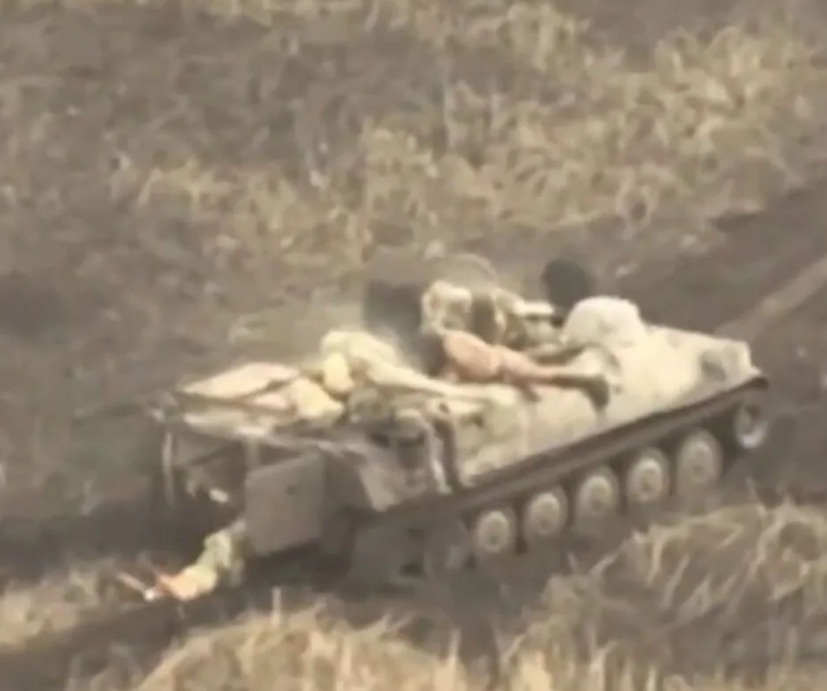
A newly surfaced battlefield video is drawing widespread attention online, challenging long-standing Russian propaganda claims that their forces “never abandon their own.” The footage, reportedly filmed during ongoing fighting in Ukraine, appears to show Russian troops retreating under pressure while leaving behind one of their own soldiers on the battlefield.
As the war in Ukraine continues, Ukrainian defense forces have intensified operations along key front-line sectors, targeting both enemy personnel and military equipment. According to multiple online sources, the viral clip captures what seems to be the aftermath of a failed assault. A Russian armored vehicle, believed to be a tank, is seen quickly withdrawing from a contested area.
In the footage, a wounded or exhausted Russian soldier can be observed lying near a roadside, attempting to reach the departing vehicle. Despite his efforts to get attention and escape the danger zone, the tank does not stop. The vehicle continues moving away, leaving the soldier behind.
The video has sparked heated discussion across social media platforms. Many commentators have pointed to the incident as a contradiction of Moscow’s repeated messaging that Russian troops stand by one another under all circumstances. The phrase “We don’t abandon our own” has frequently been used in official rhetoric and state-aligned media narratives to portray unity and loyalty within Russian ranks.
Online reactions to the video have ranged from criticism to mockery. Some users described the footage as symbolic of broader morale issues allegedly affecting Russian forces. Others argued that the clip illustrates the chaos and confusion often present in intense combat situations. While the authenticity of the footage has not been independently verified by international organizations, it has nonetheless fueled ongoing debates about battlefield conduct and military accountability.
The Ukraine war, which began in 2022, has been marked by fierce ground combat, artillery exchanges, and armored vehicle engagements across multiple regions. Both Ukrainian and Russian forces have faced significant casualties and equipment losses. In such high-risk environments, rapid tactical withdrawals are not uncommon. However, scenes suggesting abandoned personnel tend to carry strong emotional and political weight, particularly in the context of wartime messaging.
The viral clip is not the first incident to raise questions about how wounded or stranded soldiers are handled during the conflict. In separate reports circulating online, there have been allegations regarding insufficient compensation or support for injured Russian servicemen. One widely discussed claim alleged that a mobilized soldier from Russia’s Volgograd region did not receive expected financial compensation after sustaining severe battlefield injuries. While such reports remain difficult to verify independently, they continue to shape public discourse around military welfare and transparency.
Information warfare has become a central element of the Russia-Ukraine conflict. Videos, images, and battlefield updates frequently spread through social media channels within minutes, influencing public opinion both domestically and internationally. Governments on both sides have repeatedly warned citizens about misinformation, urging audiences to rely on verified sources before drawing conclusions.
Military analysts note that isolated incidents captured on video may not fully represent the broader conduct of armed forces. Combat conditions are often chaotic, and split-second decisions can determine survival. Nevertheless, symbolic footage — particularly when it contradicts official narratives — can significantly impact morale and perception.
As the war continues, such viral moments are likely to remain a powerful feature of modern conflict reporting. Whether viewed as evidence of battlefield disorganization or as propaganda amplified by opponents, the video has undeniably reignited discussion about loyalty, leadership, and responsibility in wartime.
Observers stress the importance of verifying information through trusted news outlets and official channels. In a conflict where digital media plays a strategic role, critical thinking remains essential.